
Chapter- Force
Translational and Rotational Motions
A rigid body acted upon by a force can experience two types of motion:
1. Linear or Translational Motion: 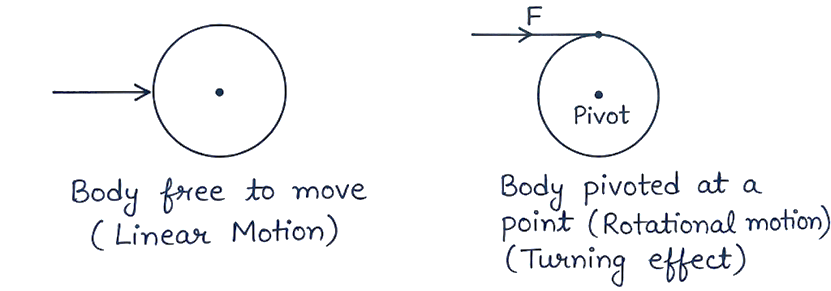
- Condition: Occurs when a force acts on a stationary rigid body that is free to move.
- Effect: The body starts moving in a straight path in the direction of the applied force.
- Example: Pushing a ball lying on the floor.
2. Rotational Motion:
- Condition: Occurs when a body is pivoted at a point (not free to move linearly), and a force is applied at a suitable point.
- Effect: The force rotates the body about the axis passing through the pivoted point. This is called the “turning effect” of the force.
- Examples: * A wheel pivoted at its center rotating when a force is applied tangentially to its rim.
- Opening a door, which rotates about the axis passing through its hinges.
Moment (Turning Effect) of a Force or Torque
When a force acts on a pivoted body, it produces a turning effect. This turning effect is called the moment of force or torque.
Factors Affecting the Turning of a Body: The turning effect depends on two crucial factors:
- The magnitude of the force applied (F).
- The perpendicular distance of the line of action of the force from the axis of rotation or pivoted point.
Formula for Moment of Force: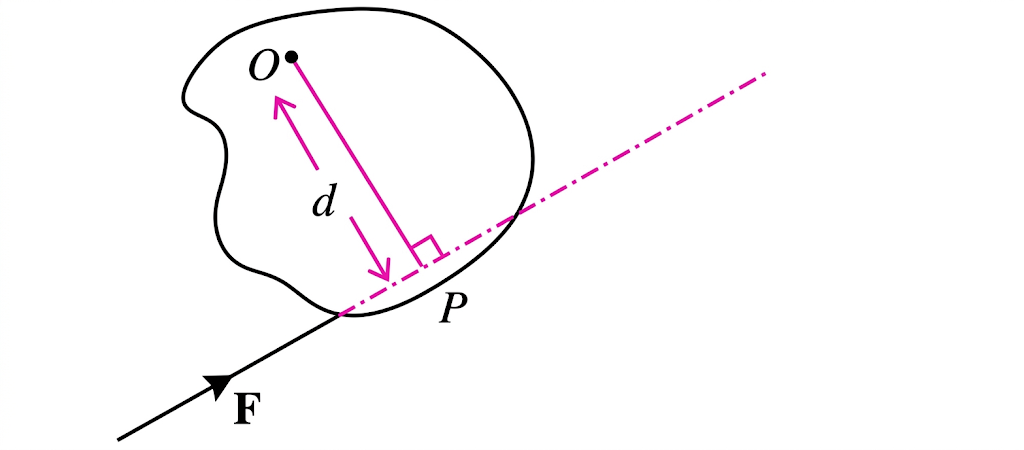
- The moment of a force is equal to the product of the magnitude of the force and the perpendicular distance of its line of action from the axis of rotation.
- Expression: Moment of force = Force × Perpendicular distance
- Symbolically: Moment of force = F×OP (where OP is the perpendicular distance).
Maximizing the Turning Effect (Key Concept):
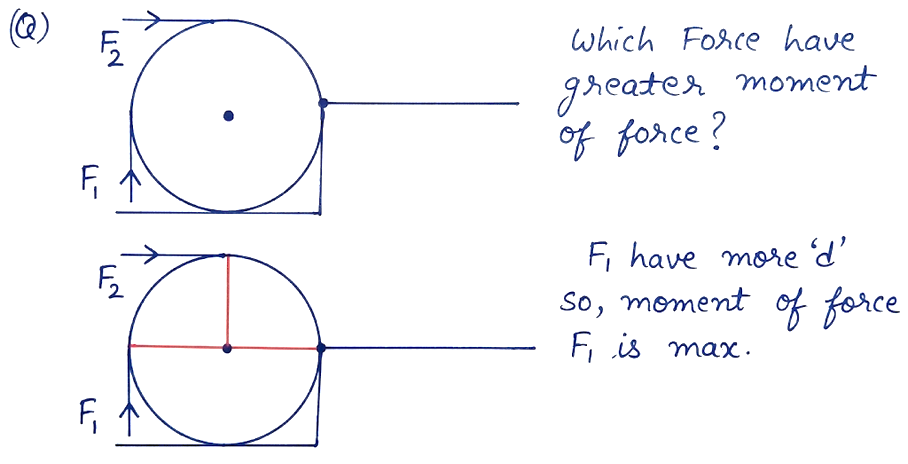
- To produce the maximum turning effect with a given force, the force must be applied at a point where the perpendicular distance from the axis of rotation is maximum.
Units of Moment of Force
- General Formula: Unit of force × unit of distance.
- S.I. Unit: newton × metre (N m).
- C.G.S. Unit: dyne × cm (dyne cm).
- Gravitational Units: * S.I. System: kgf m
- C.G.S. System: gf cm
Important Unit Conversions:
- 1 N m=105 dyne×102 cm=107 dyne cm
- 1 kgf m=9.8 N m
- 1 gf cm=980 dyne cm
🚨 Crucial ICSE Examination Points to Remember
- Keyword check: When defining Translational motion, always write “free to move”. When defining Rotational motion, always write “pivoted at a point”.
- The “Perpendicular” rule: When defining moment of force or stating its factors, simply writing “distance” is incorrect. You must write perpendicular distance from the axis of rotation.
- N m vs. Joule Exception (From the Footnote): The S.I. unit of moment of force is N m. Never write it as Joule (J). Even though Work is also measured in N m and called Joule, Work is a scalar quantity, whereas Moment of Force (Torque) is a vector quantity.
- Application Questions: The note on “Maximum Turning Effect” explains why door handles are placed at the free end of the door (farthest from the hinges)—it maximizes the perpendicular distance, requiring less force to open the door.
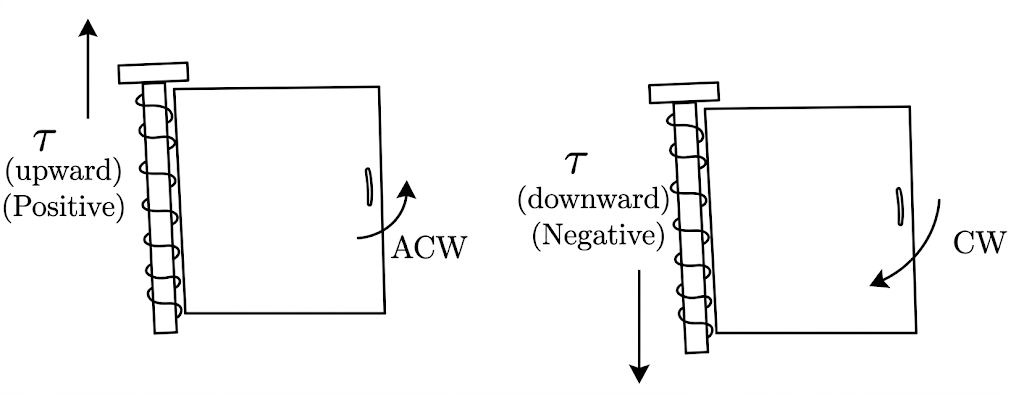
Clockwise and Anticlockwise Moments
The moment of force is a vector quantity. Its direction is determined by how it turns the body, and strict sign conventions are followed:
1. Anticlockwise Moment:
- Effect: Turns the body in an anticlockwise direction.
- Sign Convention: Taken as POSITIVE (+).
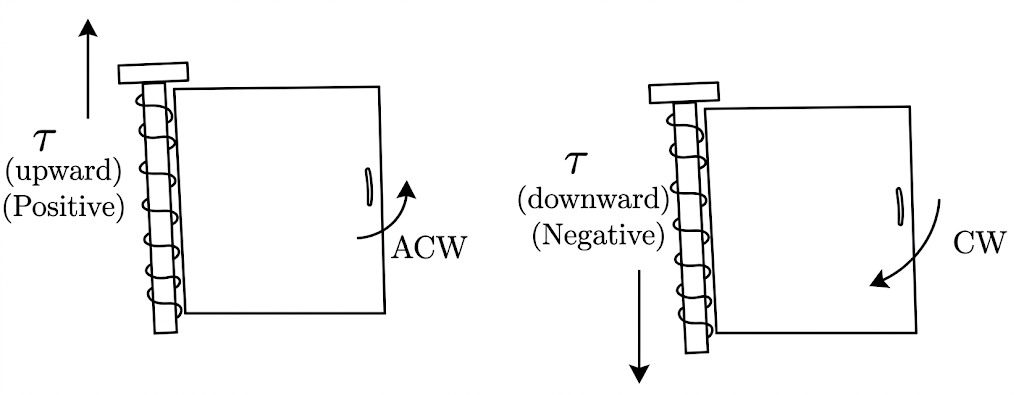
- Direction along the axis: Outwards (towards the observer).
2. Clockwise Moment:
- Effect: Turns the body in a clockwise direction.
- Sign Convention: Taken as NEGATIVE (-).
- Direction along the axis: Inwards (away from the observer).
Changing the Direction of Rotation
The direction in which a pivoted body rotates can be changed in two ways:
- By changing the point of application of the force: Keeping the force direction the same but moving where it is applied (e.g., pushing the top of a wheel vs. the bottom).
- By changing the direction of the force: Keeping the point of application the same but reversing the push/pull direction.
Common Examples of Moment of Force (Applications)
These examples demonstrate the practical application of the formula: Moment of Force = Force × Perpendicular Distance.
1. Opening or Shutting a Door:
- Observation: Handles are placed near the free end (maximum distance from the hinges).
- Reason: To maximize the perpendicular distance from the axis of rotation (hinges). This allows a smaller force to produce the maximum moment of force required to turn the door.
- What if force is applied near the hinge? A much greater force is required because the perpendicular distance is small.
- What if force is applied exactly AT the hinge? The door will not open, no matter how much force is applied. The perpendicular distance is zero, making the torque zero.
2. Hand Flour Grinder:
- Observation: The handle is placed near the outer rim of the movable upper stone.
- Reason: It provides the maximum perpendicular distance from the center pivot, allowing the heavy stone to be rotated easily with a smaller force.
3. Steering Wheel:
- Observation: Force is applied tangentially on the rim of the wheel.
- Reason: The sense of rotation can be easily changed by shifting the point of application of the force on the rim.
🚨 Crucial ICSE Examination Points to Remember
- Sign Conventions: You are often asked to calculate the net moment of force in numerical problems. You must assign a (+) sign to anticlockwise moments and a (-) sign to clockwise moments before adding them algebraically.
- The “Give Reason” Standard Answer: For any “Give reason” question asking why a handle/knob/grip is placed at the edge or rim, your answer must explicitly state: “To increase the perpendicular distance from the axis of rotation, so that the required moment of force can be produced by applying a smaller force.”
- Zero Torque Condition: A common trick question asks: “A force of 100 N is applied at the hinges of a door. What is the turning effect?” The answer is always Zero, because the perpendicular distance is 0, and F×0=0.
More Examples of Moment of Force
4. Bicycle:
- Mechanism: A small force is applied to the foot pedal of the front toothed wheel, which drives the rear wheel via a chain.
- Reason: The front wheel is larger, which provides a large perpendicular distance from the axle. This generates a sufficient moment of force to easily pull the chain and rotate the rear wheel.
5. Spanner (Wrench):
- Application: Used to tighten or loosen a nut.
- Observation: Spanners are designed with long handles, and force is applied normally (perpendicularly) at the very end.
- Reason: The long handle increases the perpendicular distance from the nut (the axis of rotation). This allows a large moment of force to be produced with only a small muscular force.
6. Jack Screw:
- Application: Used to lift heavy loads, such as vehicles.
- Observation: It is provided with a long arm.
- Reason: The long arm increases the perpendicular distance, requiring less effort to rotate it and raise the heavy load.
Core Conclusion on Turning Effect
- The turning of a body depends on both the magnitude of force and the perpendicular distance of its line of action from the axis of rotation.
- The Inverse Rule: To produce a specific turning effect, the larger the perpendicular distance, the less force is needed (and vice-versa).
Concept of a Couple
The “Hidden” Second Force: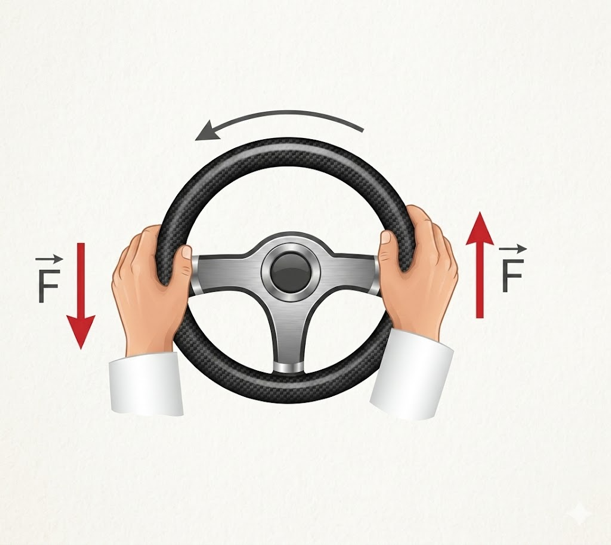
- A single force alone never causes the rotation of a pivoted body. Rotation is always produced by a pair of forces.
- When you apply an external force to a pivoted body, an equal and opposite force of reaction is generated at the pivot point.
- The turning effect (moment) of this reaction force is zero because its perpendicular distance from the axis of rotation is zero.
Definition of a Couple:
- Two equal and opposite parallel forces, not acting along the same line, form a couple.
- A couple is strictly required to produce any rotation.
Examples of Couples in Action:
- Implicit Couple (Single force applied): Opening a door.
- Force 1: The external force you exert at the handle.
- Force 2: The equal and opposite reaction force at the hinge.
- Explicit Couple (Two forces applied): Sometimes we need a larger turning effect, so we apply two forces intentionally.
- Example: Turning a car wheel nut using a cross wrench. Equal forces are applied at both ends of the wrench’s arms in opposite directions, causing both forces to turn the body in the same rotational direction (e.g., both anticlockwise).
🚨 Crucial ICSE Examination Points to Remember
- The Golden Definition: If asked to define a couple, you must write: “Two equal and opposite parallel forces, not acting along the same line.” If you omit “not acting along the same line,” your answer is technically describing forces that would simply cancel each other out (equilibrium), and you will lose marks.
- The Single Force Myth: A frequent conceptual question is: “Can a single force applied to a body produce rotation?” * Answer: No. Explain that the applied force is always paired with a reaction force at the pivot, and together they form the couple necessary for rotation.
- Spanner/Wrench Reasoning: Questions frequently ask why a long spanner is preferred over a short one to open a tight nut. Always structure your answer around the formula: State that the longer handle provides a greater perpendicular distance, thereby producing the required maximum moment of force with minimum applied effort.
Everyday Examples of a Couple
In daily life, we constantly apply a couple (two equal and opposite forces) to rotate objects without moving them in a straight line.
- Key Examples to Memorize:
- Turning a water tap.
- Tightening or loosening the cap of a bottle/inkpot.
- Turning a key in a lock.
- Turning the steering wheel of a heavy vehicle.
- Pushing the pedals of a bicycle.
Moment of a Couple (Concept & Derivation)
- The Setup: Consider a bar AB pivoted at a central point O. Two equal and opposite forces (each of magnitude F) are applied at the ends A and B.
- Couple Arm: The perpendicular distance between the two parallel forces is called the couple arm (denoted as d, where d=AB).
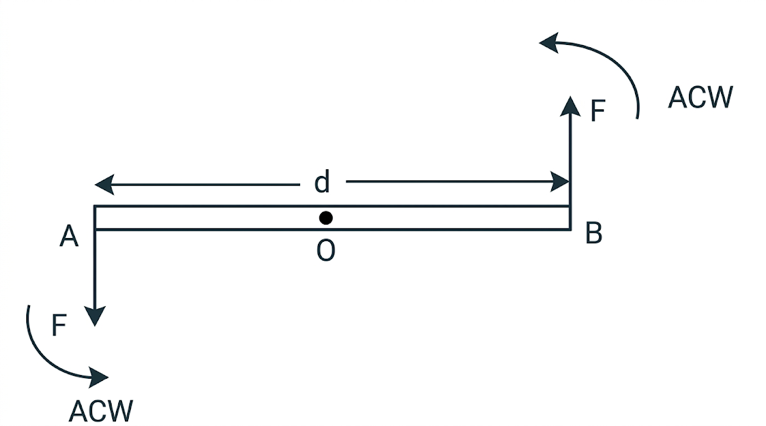
- Why is there no linear motion? The resultant sum of the two forces in any translational direction is zero (F-F=0).
- Why does rotation occur? Even though they are opposite in direction, applied at different points, both forces turn the bar in the same rotational direction (e.g., both create an anticlockwise turning effect).
Derivation of the Formula:
- Moment of force F at end A = F×OA (anticlockwise)
- Moment of force F at end B = F×OB (anticlockwise)
- Total moment of couple = Sum of the moments of both forces
- Total moment = F×OA+F×OB
- Total moment = F×OA+OB
- Since OA+OB=AB, and AB=d
- Total moment = F×d
General Formula:
- Moment of couple = Either force × perpendicular distance between the two forces (couple arm).
Equilibrium of Bodies
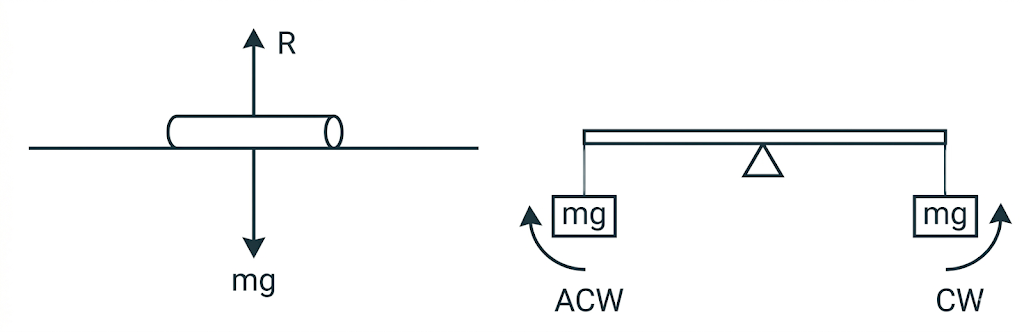
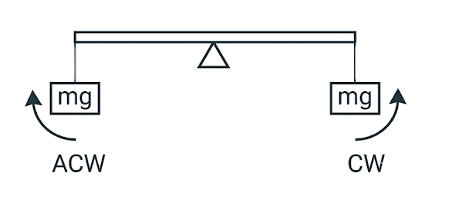
- Definition: When a number of forces acting on a body produce no change in its state of rest, or of linear or rotational motion, the body is said to be in a state of equilibrium.
- Conditions for Equilibrium: For a body to remain in equilibrium under the action of multiple forces, it must strictly satisfy the following two conditions:
- Translational Equilibrium: The resultant of all the forces acting on the body must be zero. (This ensures the body doesn’t start moving in a straight line).
- Rotational Equilibrium: The algebraic sum of moments of all the forces about the fixed point (pivot) must be zero. (This ensures the body doesn’t start rotating).
🚨 Crucial ICSE Examination Points to Remember
- Couple vs. Moment of Couple: Be careful with definitions. A “couple” refers to the pair of forces themselves. The “moment of a couple” refers to the turning effect produced by those forces.
- Derivation Importance: The mathematical derivation proving that the moment of a couple is F×d is a frequent 2-mark or 3-mark question. Practice writing it step-by-step exactly as outlined above.
- The “Algebraic Sum” Keyword: When stating the second condition of equilibrium, you must write the word “algebraic” sum of moments. This specific word implies that clockwise (negative) and anticlockwise (positive) moments perfectly cancel each other out. Writing just “sum of moments” is technically incomplete and often results in lost marks.
Kinds of Equilibrium
Equilibrium is broadly classified into two types based on the state of the body:
1. Static Equilibrium
- Definition: When a body remains in a state of rest under the influence of several forces, it is in static equilibrium.
- Classic Examples:
- A book lying on a table: The weight of the book acting vertically downwards is perfectly balanced by the equal and opposite normal reaction force exerted by the table upwards.
- A horizontal beam balance: It is in static rotational equilibrium because the clockwise moment (due to the object) perfectly balances the anticlockwise moment (due to the standard weights), resulting in no net rotational motion.
- A stationary body pulled by opposing forces: If a block is pulled to the left and right by equal forces along the same line, the net force is zero, and it does not move.
2. Dynamic Equilibrium
- Definition: When a body remains in the same state of motion (either constant translational velocity or constant rotational velocity) under the influence of several forces, it is in dynamic equilibrium.
- Classic Examples (Highly Testable):
- A falling raindrop: It reaches the earth’s surface with a constant velocity (terminal velocity). This happens because its downward weight is exactly balanced by the sum of two upward forces: the buoyant force and the force of friction (viscous drag) of the air.
- An aeroplane at a constant altitude: The upward lift balances its downward weight.
- Planetary/Atomic motion: A planet moving around the sun, or an electron around a nucleus, is in dynamic equilibrium. The force of attraction provides the necessary centripetal force for uniform circular motion.
Conditions for Equilibrium (Consolidated)
For a body to be in either static or dynamic equilibrium, these two fundamental conditions must be met:
- Translational: The resultant (net) of all forces acting on the body must be zero.
- Rotational: The algebraic sum of moments of all forces about the point of rotation must be zero. (i.e., Total Anticlockwise Moments = Total Clockwise Moments).
Principle of Moments (Introduction)
- When multiple forces act on a pivoted body, they all try to rotate it.
- To find the overall turning effect, we calculate the resultant moment by taking the algebraic sum of each individual moment.
- Strict Sign Convention: Anticlockwise moment = Positive (+)
Clockwise moment = Negative (-)
🚨 Crucial ICSE Examination Points to Remember
- Spotting Dynamic Equilibrium: Students often mistakenly associate “equilibrium” only with objects at rest. Emphasize that constant velocity (like the falling raindrop or a car moving at a steady speed on a straight road) is the key indicator of dynamic equilibrium.
- The Raindrop Question: A very frequent 2-mark question asks to “name the forces keeping a falling raindrop in dynamic equilibrium.” The required answer must list all three: (1) Downward weight, (2) Upward buoyant force, and (3) Upward viscous drag (friction) of the air.
- Circular Motion Nuance: For the planet revolving around the sun, ensure it is clear that while the speed might be constant, the direction is changing. It is in dynamic equilibrium because the gravitational pull is perfectly acting as the centripetal force, maintaining the orbital path without crashing or escaping.
Principle of Moments (Formal Statement)
- The Principle: According to the principle of moments, when a body is in equilibrium, the sum of the anticlockwise moments is equal to the sum of the clockwise moments about the axis of rotation.
- Formula: Sum of anticlockwise moments = Sum of clockwise moments.
- Practical Application: A physical balance (or beam balance) works directly on this principle to compare unknown masses with standard weights.
Verification of the Principle of Moments (Experiment)
This simple experiment visually and mathematically proves the principle. 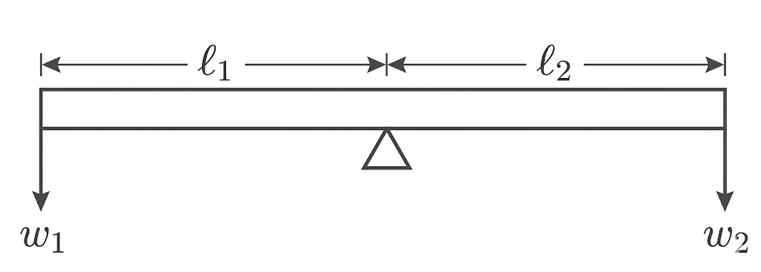
1. The Setup:
- Suspend a uniform metre rule horizontally from a fixed support using a strong thread at its center (Point O). This point acts as the pivot.
- Suspend two weights, W1 and W2, from the rule on opposite sides of the pivot.
2. Achieving Equilibrium:
- Initially, the rule might tilt.
- Adjust the positions (distances) or the magnitude of the weights until the metre rule becomes perfectly horizontal again. This horizontal state indicates rotational equilibrium.
3. The Calculations:
- Right Side: Let weight W1 be suspended at a distance l1 from the pivot (OA=l1).
- W1 tends to turn the rule clockwise.
- Clockwise moment = W1×l1
- Left Side: Let weight W2 be suspended at a distance l2 from the pivot (OB=l2).
- W2 tends to turn the rule anticlockwise.
- Anticlockwise moment = W2×l2
4. The Conclusion:
- When the rule is perfectly horizontal (in equilibrium), calculations will consistently show that:
- W1×l1=W2×l2
- (i.e., Clockwise moment = Anticlockwise moment). This verifies the principle.
🚨 Crucial ICSE Examination Points to Remember
- The “State the Principle” Question: If asked to state the Principle of Moments, you must include the condition “in equilibrium”. Writing just “sum of anticlockwise moments = sum of clockwise moments” without stating it applies to a body in equilibrium will cost you marks.
- Numerical Goldmine: This specific setup (a metre rule balanced on a fulcrum) is the foundation for almost all moment-based numericals in Section A of your physics paper. The core strategy is always to identify the pivot, calculate all clockwise moments, calculate all anticlockwise moments, and equate them.
- Weight of the Rule: In this specific verification, the rule is pivoted exactly at its center of gravity (usually the 50 cm mark), so the weight of the rule itself doesn’t produce any turning effect. Be careful in numericals where the pivot is NOT at the center; in those cases, the weight of the rule itself will create a moment!
Formative Assessment : Multiple Choice Questions (MCQs)
1. A mechanic is trying to loosen a tightly fitted nut using a spanner but is unsuccessful. According to physics principles, which of the following actions will most effectively help him loosen the nut with the least muscular effort?
A) Applying the same force closer to the nut.
B) Applying a smaller force at the same point.
C) Using a spanner with a longer handle and applying force perpendicularly at the end.
D) Striking the spanner with a single, sudden, non-perpendicular force.
2. A raindrop falls from the sky and eventually reaches the earth’s surface with a constant terminal velocity. What is the physical state of the raindrop during this constant velocity phase?
A) Static Equilibrium
B) Dynamic Equilibrium
C) Translational Non-Equilibrium
D) Rotational Equilibrium only
3. In an examination, a student calculates the turning effect of a force and writes the final answer as “50 Joules”. According to standard convention, why would an ICSE examiner deduct marks for this answer?
A) The numerical value is physically impossible for turning effects.
B) Turning effect should be measured in kgf m exclusively.
C) Work and Moment of Force are both vector quantities, but have different units.
D) Work is a scalar quantity while Moment of Force is a vector, so N m should not be written as Joule.
4. A force of 100 N is applied exactly at the hinges of a heavy wooden door. What is the moment of force produced to open the door?
A) 100 N m
B) Maximum, because the force is large.
C) Zero
D) Depends on the length of the door.
5. Which of the following is the strictly correct and complete condition to define a “couple” in physics?
A) Two parallel forces acting on a body.
B) Two equal and opposite parallel forces acting along the same line.
C) Two equal and opposite parallel forces, not acting along the same line.
D) Any two forces that produce rotation in the same direction.
6. To convert a torque measurement from gravitational S.I. units to the absolute C.G.S. unit, which of the following relationships is mathematically correct?
A) 1 kgf m=9.8×10⁷ dyne cm
B) 1 kgf m=9.8×10⁵ dyne cm
C) 1 N m=980 dyne cm
D) 1 gf cm=107 dyne cm
7. When you ride a bicycle, you apply a small force to the foot pedal. Why is the front toothed wheel designed to be larger than the rear wheel?
A) To reduce the friction on the chain.
B) To provide a large perpendicular distance from the axle, generating a sufficient moment of force.
C) To decrease the couple arm between the pedals.
D) To ensure the center of gravity of the bicycle remains low.
8. A student states the Principle of Moments as: “The sum of anticlockwise moments is equal to the sum of clockwise moments.” Why is this statement conceptually incomplete for an exam?
A) It does not specify that the moments must be measured in N m.
B) It omits the crucial condition that the body must be “in equilibrium”.
C) It fails to mention that moments must be taken from the center of gravity.
D) It does not define whether the forces are parallel or non-parallel.
9. When a body is completely free to move (not pivoted at any point) and a force acts upon it, what kind of motion is produced?
A) Only rotational motion
B) Only linear or translational motion
C) A combination of linear and rotational motion
D) A couple
10. When calculating the net moment of force on a pivoted body, what is the strict sign convention that must be followed before algebraically adding the moments?
A) Clockwise is POSITIVE (+), Anticlockwise is NEGATIVE (-)
B) Both Clockwise and Anticlockwise are added without signs.
C) Anticlockwise is POSITIVE (+), Clockwise is NEGATIVE (-)
D) Upward forces are POSITIVE (+), Downward forces are NEGATIVE (-)
11. Which of the following examples perfectly demonstrates the application of an “explicit couple” (where two external forces are intentionally applied)?
A) Pushing a ball lying on the floor.
B) Opening a door by pushing the handle.
C) Turning a car wheel nut using a cross wrench.
D) A book lying perfectly still on a table.
12. In the verification of the Principle of Moments experiment using a metre rule suspended at the 50 cm mark, why does the weight of the rule itself NOT produce any turning effect?
A) Because the rule is weightless in dynamic equilibrium.
B) Because the pivot is placed exactly at its center of gravity, making the perpendicular distance zero.
C) Because the upward tension in the thread cancels the rule’s weight.
D) Because the rule is suspended horizontally.
13. A planet moving around the sun in a uniform circular orbit is an example of which physical state?
A) Static Equilibrium
B) Dynamic Equilibrium
C) Rotational Non-Equilibrium
D) Linear Acceleration
14. Can a single external force applied to a pivoted body produce rotation on its own?
A) Yes, if the force is applied at a maximum perpendicular distance.
B) Yes, if the force is applied tangentially.
C) No, rotation is always produced by a pair of forces; the external force pairs with a reaction force at the pivot.
D) No, because single forces only produce translational motion.
15. If a body is strictly in translational equilibrium, which of the following conditions MUST be perfectly satisfied?
A) The algebraic sum of moments of all forces about a fixed point is zero.
B) The turning effect of the forces is maximized.
C) The resultant (net) of all the forces acting on the body must be zero.
D) The body must be completely at rest.
Part II: Assertion-Reasoning Questions
For questions 16 to 20, select the correct option from the following:
- A. Both Assertion (A) and Reason (R) are true and R is the correct explanation of A.
- B. Both A and R are true but R is not the correct explanation of A.
- C. A is true but R is false.
- D. A is false but R is true.
16. Assertion (A): The handles of a hand flour grinder are placed near the outer rim of the movable upper stone rather than near the center.
Reason (R): Placing the handle at the outer rim maximizes the perpendicular distance from the center pivot, allowing the stone to be rotated with a smaller force.
17. Assertion (A): A heavy door can be opened by applying a force exactly at its hinges if the applied force is exceptionally large.
Reason (R): The moment of force strictly depends on both the magnitude of the force applied and the perpendicular distance from the axis of rotation.
18. Assertion (A): A book lying stationary on a flat table is in a state of dynamic equilibrium.
Reason (R): When a body remains in a state of rest under the influence of several forces, it is said to be in static equilibrium.
19. Assertion (A): Even though Work and Moment of Force both have the fundamental unit formulation of Force × Distance, you must never write the unit of Moment of Force as Joule (J).
Reason (R): Work is a scalar quantity, whereas Moment of Force (Torque) is a vector quantity.
20. Assertion (A): Two equal and opposite parallel forces acting perfectly along the same line of action form a couple and produce rotation.
Reason (R): A couple strictly requires the two equal and opposite parallel forces to act at different points (not along the same line) to generate a turning effect.
Answer Key and Expert Explanations
1. C | Explanation: To produce the maximum turning effect with a given force, the force must be applied at a point where the perpendicular distance from the axis of rotation is maximum. Spanners are designed with long handles to increase this perpendicular distance, allowing a large moment of force to be produced with a small muscular force.
2. B | Explanation: When a body remains in the same state of motion (such as constant translational velocity) under the influence of several forces, it is in dynamic equilibrium. A falling raindrop is a classic example of this, reaching constant (terminal) velocity.
3. D | Explanation: The S.I. unit of moment of force is N m. It should never be written as Joule (J) because Work is a scalar quantity, whereas Moment of Force (Torque) is a vector quantity.
4. C | Explanation: If force is applied exactly at the hinge, the perpendicular distance from the axis of rotation is zero. Because the formula is Force × Perpendicular distance, F×0=0, making the moment of force zero.
5. C | Explanation: A couple is strictly defined as two equal and opposite parallel forces, not acting along the same line. Omitting “not acting along the same line” describes forces that would cancel each other out.
6. A | Explanation: 1 kgf m is equal to 9.8 N m. Since 1 N m is equal to 107 dyne cm, multiplying 9.8 by 107 gives 9.8×10⁷ dyne cm.
7. B | Explanation: In a bicycle, the front wheel is larger to provide a large perpendicular distance from the axle. This generates a sufficient moment of force to pull the chain and rotate the rear wheel easily.
8. B | Explanation: If asked to state the Principle of Moments, you must include the condition “in equilibrium”. Stating the sum of moments equality without this condition will result in lost marks.
9. B | Explanation: Linear or Translational Motion occurs when a force acts on a stationary rigid body that is free to move. The keyword for translational motion is “free to move”.
10. C | Explanation: Strict sign conventions dictate that anticlockwise moments are taken as POSITIVE (+) and clockwise moments are taken as NEGATIVE (-).
11. C | Explanation: Turning a car wheel nut using a cross wrench is an example of an explicit couple, where two forces are applied intentionally at both ends of the wrench’s arms.
12. B | Explanation: In the verification experiment, the rule is pivoted exactly at its center of gravity (the 50 cm mark). Because the pivot is here, the perpendicular distance for the rule’s weight is zero, so it doesn’t produce a turning effect.
13. B | Explanation: Planetary motion, such as a planet moving around the sun, is an example of dynamic equilibrium. The force of attraction acts as the necessary centripetal force.
14. C | Explanation: A single force alone never causes the rotation of a pivoted body; rotation is always produced by a pair of forces. An applied force pairs with an equal and opposite reaction force at the pivot to form a couple.
15. C | Explanation: The specific condition for Translational Equilibrium is that the resultant (net) of all the forces acting on the body must be zero.
16. A | Explanation: The assertion is true as handles are placed on the outer rim. The reason is correctly stating that this placement provides the maximum perpendicular distance from the pivot, allowing easy rotation with a smaller force.
17. D | Explanation: The assertion is false; the door will not open if force is applied exactly at the hinge, no matter how much force is applied, because the perpendicular distance is zero. The reason is true, as moment depends on both force and perpendicular distance.
18. D | Explanation: The assertion is false; a book lying on a table is in static equilibrium, not dynamic. The reason accurately defines static equilibrium as a body remaining at rest under the influence of several forces.
19. A | Explanation: The assertion accurately states that N m must never be written as Joule. The reason is the correct explanation: Work is a scalar quantity, while Moment of Force is a vector.
20. D | Explanation: The assertion is false; if the equal and opposite forces act exactly along the same line, they cancel each other out and do not form a couple. The reason correctly defines that a couple requires the forces to not act along the same line.
Centre of Gravity (C.G.)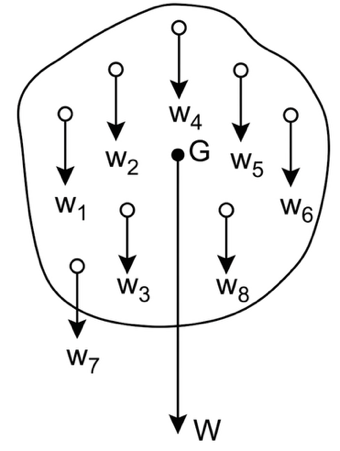
The Basic Concept:
- The Earth attracts every particle of a body towards its centre. The force of this attraction on each particle is its weight (w1,w2,w3…).
- Because a standard object is very small compared to the Earth, the gravitational forces acting on its individual particles are considered to be parallel to each other.
- All these individual, downward parallel forces can be replaced by a single resultant force, which is the total weight (W) of the body (W=w1+w2+w3+…).
Defining Centre of Gravity:
- Formal Definition: The centre of gravity of a body is the point about which the algebraic sum of moments of weights of all the particles constituting the body is zero.
- Practical Meaning: It is the single point where the entire weight of the body can be considered to act, regardless of the body’s orientation or how it is placed.
Crucial Properties of C.G.
1. Dependence on Mass Distribution:
- For a body of a given mass, the position of its C.G. depends strictly on its shape, i.e., the distribution of mass of its particles.
- If a body is deformed (its shape is changed), the position of its C.G. will change.
- Example: A straight uniform wire has its C.G. at the exact middle of its length. If that same wire is bent into a closed circle, its C.G. shifts to the geometric centre of the circle.
2. Location Outside the Material:
- It is not necessary for the C.G. to always lie within the solid material of the body itself. It can exist in empty space.
- Example: The C.G. of a uniform ring, a hollow sphere, or a hollow cylinder lies exactly at its central axis/centre, where there is no physical material.
🚨 Crucial ICSE Examination Points to Remember
- The “Zero Moment” Requirement: When asked to define the Centre of Gravity, writing “the point where the whole weight acts” will often only fetch partial marks. You must include the technical phrase: “the point about which the algebraic sum of moments of weights of all particles is zero.”
- “Name a Body…” Questions: A highly repeated 1-mark question is: “Name a body whose centre of gravity lies outside its physical material.” The safest and most standard answers are “a uniform ring” or “a hollow sphere.”
- “Give Reason” on Deformation: If asked why the C.G. of a piece of clay changes when molded from a sphere into a cylinder, the exact keyword required in your answer is that the “distribution of mass” has changed.
Centre of Gravity of Regular Objects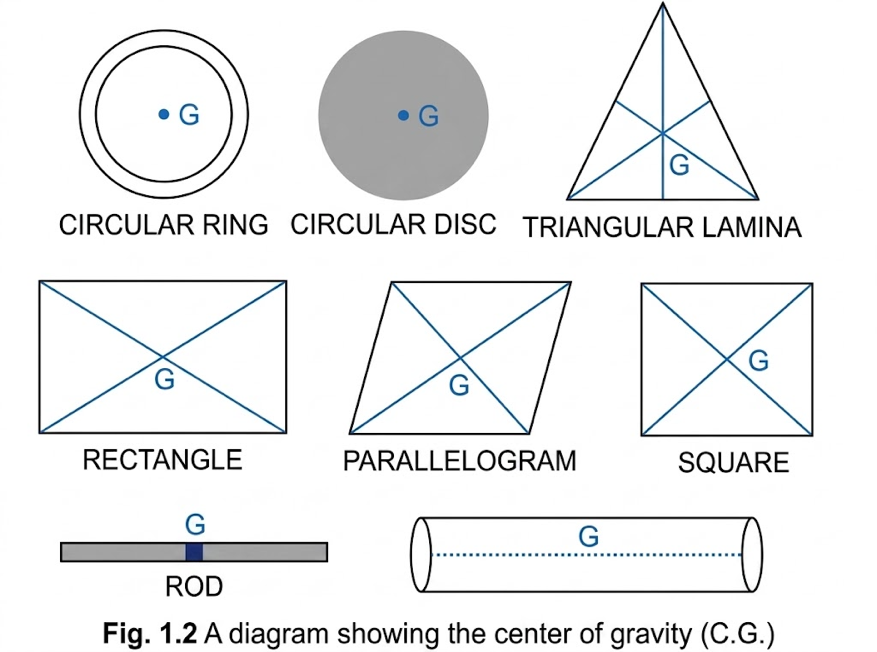
By utilizing the concept of the centre of gravity (C.G.), any body of weight W can be treated mathematically as a single point particle of weight W located exactly at its C.G.
For bodies with regular shapes and uniform mass distribution, the C.G. lies at their geometric centre. Here is the standard list to memorize:
1-Dimensional & 2-Dimensional Shapes:
- Uniform Rod: Mid-point of the rod.
- Circular Ring: Centre of the ring.
- Circular Disc: Geometric centre of the disc.
- Triangular Lamina (or any triangle): The point of intersection of its medians.
- Parallelogram, Rectangle, Square, or Rhombus: The point of intersection of their diagonals.
3-Dimensional Shapes:
- Solid or Hollow Sphere: Geometric centre of the sphere.
- Solid or Hollow Cylinder: Mid-point on the central axis of the cylinder.
The Cones (Crucial Distinction):
- Solid Cone: At a height of h/4 from the base, on its central axis (where h is the total vertical height of the cone).
- Hollow Cone: At a height of h/3 from the base, on its central axis.
Centre of Gravity and the Balance Point
- The Balancing Rule: A solid body can be perfectly balanced by supporting it physically at its centre of gravity.
- The Metre Rule Example: A standard uniform metre rule (100 cm long) has its uniform mass distributed evenly. Therefore, its geometric centre is at the 50 cm mark. If you place a knife-edge pivot exactly at the 50 cm mark, the rule will balance horizontally.
🚨 Crucial ICSE Examination Points to Remember
- The “Cone” Trap: Examiners love asking for the C.G. of a cone. Pay very close attention to whether the question specifies a solid cone (h/4) or a hollow cone (h/3). Getting these swapped is one of the most common errors.
- Triangle Terminology: For a triangular lamina, you must write “point of intersection of medians”. If you write “intersection of altitudes,” “intersection of bisectors,” or just “centre,” you will lose marks.
- Lamina Keyword: You might see the word “lamina” used frequently (e.g., rectangular lamina, triangular lamina). A lamina is simply a very thin, flat 2D sheet of uniform material (like a piece of cardboard cut into a shape).
- The 50 cm Assumption: In numerical problems involving a uniform metre rule, unless stated otherwise, you must always assume that the entire weight of the rule itself acts precisely downwards at the 50 cm mark.
Balancing a Body at its C.G.
- The Core Reason: A body balances when supported at its Centre of Gravity (C.G.) because the algebraic sum of moments of the weights of all its particles about that support point is exactly zero.
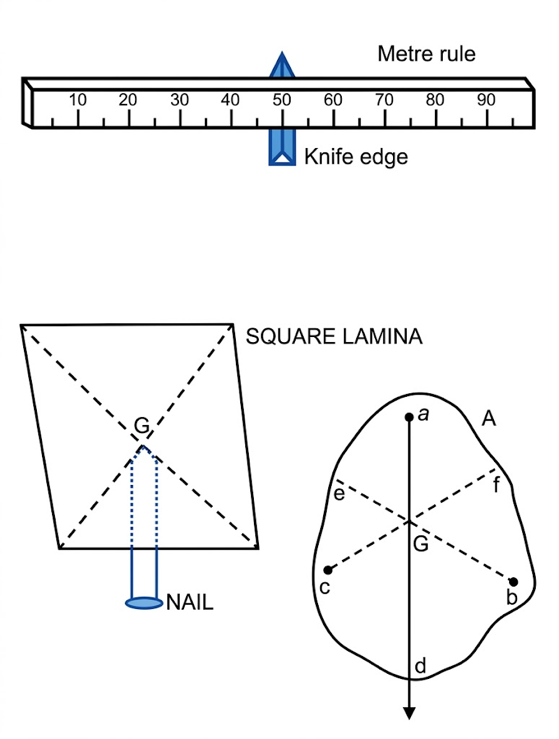
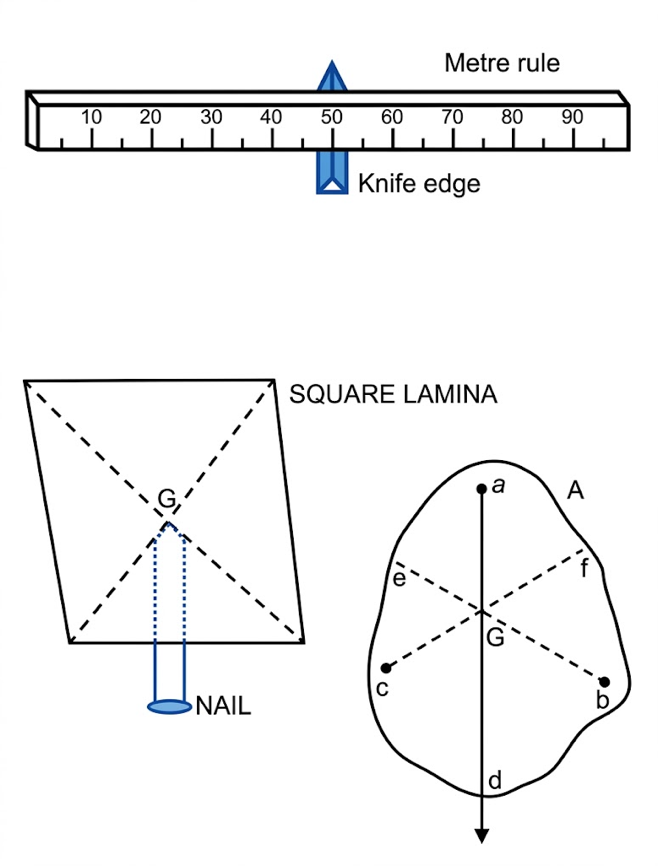
- Metre Rule Example: A uniform metre rule balances perfectly on a knife-edge at the 50 cm mark.
- Square Lamina Example: A square thin sheet can be perfectly balanced horizontally on the tip of a nail placed at the intersection of its diagonals.
The Principle of Free Suspension
- The Rule: If a body is freely suspended from any point, it will always come to rest (balance) in a position where its centre of gravity lies vertically below the point of suspension.
- Application: This fundamental fact is used practically to locate the exact position of the C.G. for oddly shaped or irregular objects.
Experiment: Finding the C.G. of an Irregular Lamina
This is a standard laboratory method using a plumb line.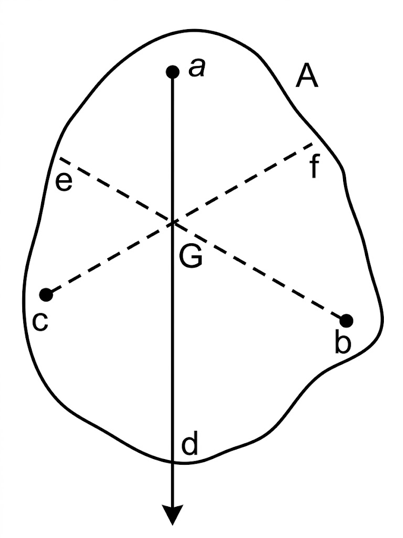
1. Setup & Preparation:
- Take the irregular lamina (let’s call it A) whose C.G. needs to be found.
- Make three fine holes (a, b, and c) near the edges of the lamina, spaced well apart.
2. Suspension Process:
- Suspend the lamina from hole a using a pin or nail clamped horizontally to a retort stand.
- Crucial Step: Check that the lamina is free to oscillate on the nail (it shouldn’t be stuck or rubbing against the stand).
- Suspend a plumb line from the exact same pin.
3. Tracing the Vertical:
- Wait for both the lamina and the plumb line to come to a complete rest.
- Using a pencil, draw a straight line directly behind the plumb line on the lamina (let’s name this line ad).
- Why? Because of the principle of free suspension, the C.G. must lie somewhere on this vertical line ad.
4. Repeat & Intersect:
- Repeat the entire suspension and tracing procedure using hole b. Draw the new plumb line path (line be).
- Repeat once more using hole c. Draw the plumb line path (line cf).
5. Conclusion:
- Observation: You will notice that all three traced lines (ad, be, and cf) intersect exactly at one common point.
- Result: This point of intersection (labeled G) is the Centre of Gravity of the irregular lamina.
🚨 Crucial ICSE Examination Points to Remember
- The Plumb Line’s Purpose: A common viva or short-answer question asks why a plumb line is used. The answer is: “A plumb line always hangs completely vertical under the influence of Earth’s gravity, directly indicating the vertical line that passes through the Centre of Gravity.”
- “Free to Oscillate”: If asked for precautions during this experiment, the most important one to write is that the lamina must be completely free to swing. If there is friction against the stand, it won’t settle in the true vertical position, leading to an incorrect C.G. location.
- Minimum Number of Suspensions: Technically, you only need to suspend the lamina from two different points to find the intersection. The third suspension (hole c) is done simply to verify and confirm the accuracy of the point G.
Uniform Circular Motion
Definition & Basic Concept:
- Definition: When a particle moves with a constant speed in a circular path, its motion is called uniform circular motion.
- Mechanism: The particle travels equal distances along the circular path in equal intervals of time. Therefore, its speed remains completely uniform.
The Speed vs. Velocity Paradox (Core Concept):
- Speed (Scalar): The speed of the particle is completely constant (uniform).
- Direction: The direction of motion is never constant; it changes continuously at every single point along the circular path.
- Velocity (Vector): Because velocity depends on both magnitude (speed) and direction, a change in direction means the velocity is changing. Thus, in uniform circular motion, the velocity is non-uniform (variable).
The Accelerated Nature of UCM:
- Because the velocity is continuously changing (due to the changing direction), uniform circular motion is strictly an accelerated motion.
Direction of Velocity at any Instant
- The Tangent Rule: At any specific point on the circular path, the precise direction of motion (and therefore the direction of the velocity vector) is along the tangent drawn at that point of the circle.
Visualizing the Direction Change (Referencing Fig 1.42):
- Consider a particle moving in a horizontal plane with uniform speed v in an anticlockwise direction.
- Let T be the total time for one full revolution. It takes t=T/4 to complete each quarter of the circle.
- At Point A: The tangent points straight North.
- At Point B (after a quarter circle): The tangent points straight West.
- At Point C (after a half circle): The tangent points straight South.
- Conclusion: Even though the speed v is identical at points A, B, and C, the velocity is entirely different because the compass direction has completely changed.
🚨 Crucial ICSE Examination Points to Remember
- The “Accelerated Motion” Trap: This is one of the most frequently asked 2-mark conceptual questions. Question: “A body moving in a circular path at a constant speed is said to be accelerating. Give a reason.” Answer: “Velocity is a vector quantity. In circular motion, while the speed is constant, the direction of motion changes continuously at every point. This continuous change in direction means the velocity is continuously changing, making it an accelerated motion.”
- Identify the Constant: You may be asked: “Name a quantity that remains constant in uniform circular motion.” The correct answer is Speed (or Kinetic Energy). If you write Velocity, it is entirely incorrect.
- Diagramming Velocity: If a question asks you to indicate the direction of velocity at a point P on a circle, you must use a ruler to draw a perfectly straight line tangent to the circle at P, pointing in the direction of the body’s rotation. Never draw a curved arrow to represent velocity!
Uniform Linear Motion vs. Uniform Circular Motion
This is a classic comparison that highlights why circular motion is special.
1. Uniform Linear Motion:
- Path: The body moves along a straight line.
- Speed: Constant.
- Direction: Constant (it does not change).
- Velocity: Constant (since both speed and direction are unchanged).
- Acceleration: Zero. It is an unaccelerated motion.
2. Uniform Circular Motion:
- Path: The body moves along a circular path.
- Speed: Constant (Uniform).
- Direction: Continuously changing at every point.
- Velocity: Variable (because the direction changes).
- Acceleration: Present. It is strictly an accelerated motion.
Centripetal Force
According to Newton’s First Law, a body moving in a straight line will not change its direction unless an external force acts on it.
The Need for Force in Circular Motion:
- In circular motion, a particle continuously changes its direction at every single point.
- This continuous change in direction (and thus, velocity) is impossible without an external force acting on the particle continuously.
Definition and Direction:
- Centripetal Force: The continuous force required to keep a body moving in a circular path is termed the centripetal force.
- Etymology: The word “centripetal” literally means “centre seeking”.
- Direction: At any given point on the circular path, this force is always directed towards the centre of the circle.
Nature of Acceleration in Circular Motion:
- Because the force is directed towards the centre, the resulting acceleration is also directed towards the centre.
- As the particle moves around the circle, the direction of the centre relative to the particle constantly changes.
- Therefore, while the magnitude of the acceleration remains the same, the direction of acceleration changes continuously.
- Conclusion: The acceleration in uniform circular motion is variable (or non-uniform).
🚨 Crucial ICSE Examination Points to Remember
- The “Difference” Question: A very common 2-mark question asks to “State two differences between uniform linear motion and uniform circular motion.” Your two points should always be: (1) Linear has constant velocity while circular has variable velocity, and (2) Linear is unaccelerated while circular is an accelerated motion.
- Defining Centripetal Force: If asked to define it, ensure you include both its function and its direction. For example: “It is the force required to move a body in a circular path, and it is always directed towards the centre of the circle.”
- The Acceleration Trap: You might see a true/false or fill-in-the-blank question asking if the acceleration in uniform circular motion is constant. The answer is False / Variable. Only the magnitude of acceleration is constant; the acceleration vector itself is changing because its direction is always shifting to point at the centre from a new position.